
Blog
-
 CEO Desk
-
Cochin
-
Date : 14/07/2026
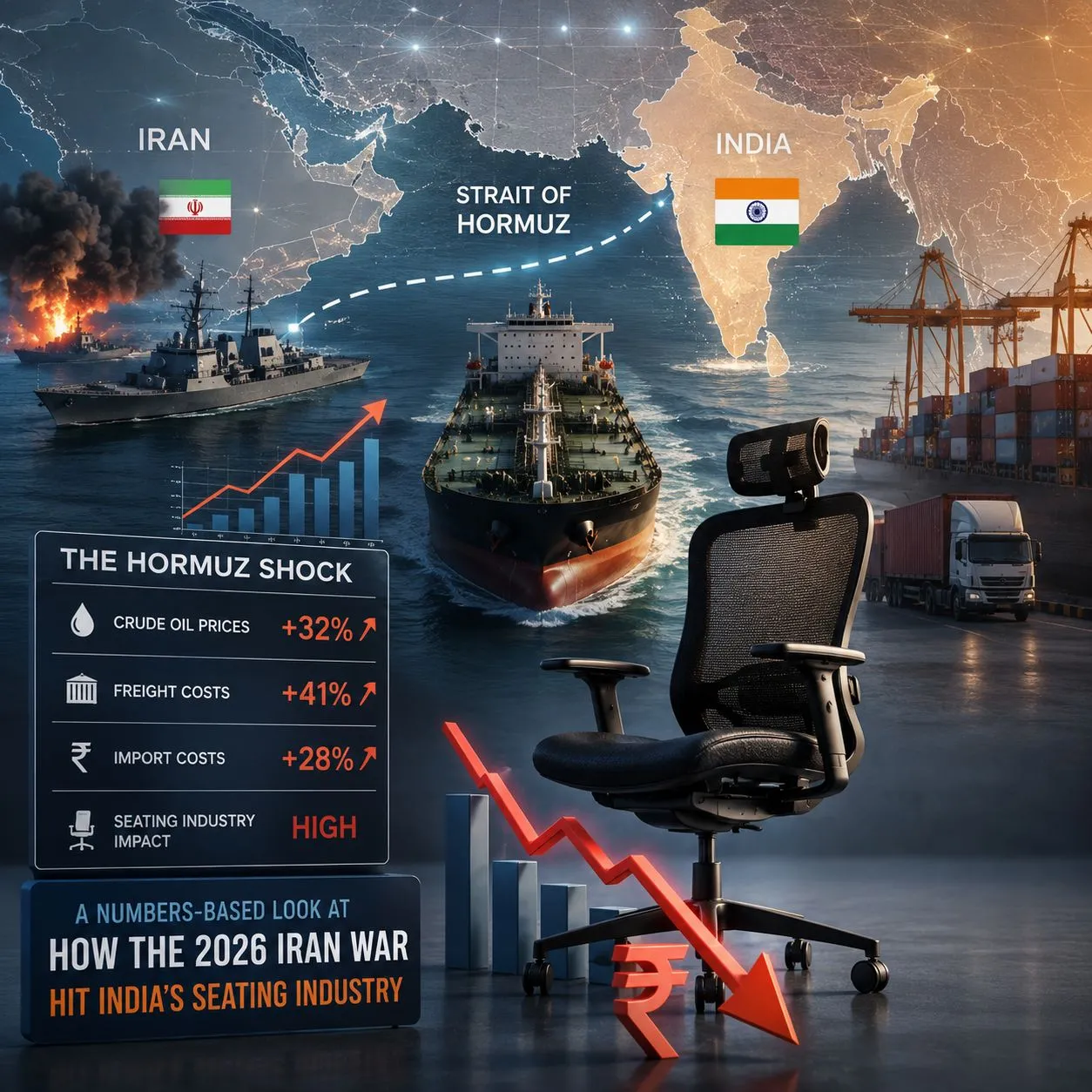
Four decades of tracking input costs in this industry teaches you to distrust any sentence that starts with "the war affected prices." It affected specific prices, by specific amounts, on specific dates and if we can't point to the number, we probably shouldn't be writing the sentence. So here is what actually happened, with the figures attached, and what it meant for anyone manufacturing office chairs and modular furniture in India this year.
The timeline, in numbers
On 28 February 2026, the US and Israel launched joint strikes on Iran. Brent crude, trading at USD 71.32 a barrel before the strikes, jumped to USD 77.24 within two trading days an 8% move. That was just the opening. By 2 March, Brent was up 10–13% to the USD 80–82 range. Iran responded by disrupting tanker traffic through the Strait of Hormuz, the channel that carries roughly a fifth of the world's seaborne oil and LNG and by 4 March the strait was effectively closed to shipping. Brent surged past USD 120 a barrel. Gulf oil production from Saudi Arabia, the UAE, Kuwait and Iraq collectively fell by a reported 6.7 million barrels a day by 10 March, and by at least 10 million barrels a day by 12 March. On 18 March, an Israeli strike on Iran's South Pars gas field, the largest gas field in the world pushed Brent to USD 108.66 a barrel in a single 5% jump. By late April, industry estimates put cumulative lost oil production at 600–700 million barrels, with Vitol's CEO warning the eventual toll could reach a billion barrels. The International Energy Agency called it, in plain language, "the greatest global energy security challenge in history" a bigger supply shock than either the 1973 Arab oil embargo or the 2022 Russia-Ukraine disruption.
For India specifically, the numbers were blunt. India imports over 85% of its crude oil, with roughly half of that transiting the Strait of Hormuz; it sources about 80% of its natural gas and 91% of its LPG from the Gulf. India's crude oil basket price rose from below USD 80 to approximately USD 140 a barrel at the peak. The rupee fell to a record low of 94.79 to the US dollar. The central government cut excise duty on petrol and diesel by ₹10 a litre each to cushion consumers, at real cost to tax revenue.
A ceasefire process began taking shape through April and June, with a preliminary US-Iran deal reported in mid-June 2026 opening a 60-day negotiation window. By 2 July 2026, Brent had fallen back below USD 71 a barrel technically back to pre-war levels though analysts were clear that this reflected optimism about a durable peace rather than any actual restoration of Gulf production and shipping to normal, and that full inventory and output recovery could take "months, if not beyond a year."
What this did to the two materials that make up a chair
An office chair, reduced to its bill of materials, is mostly two things: a steel frame and a petrochemical-derived foam or fabric system. Both moved sharply during the war window.
Steel. Within 48 hours of the Hormuz crisis escalating, Indian mills moved first SAIL raised hot-rolled flat product prices by roughly ₹500 per metric tonne for March deliveries, JSW Steel followed with a similar ₹500/MT increase on HRC and plates, and Tata Steel matched it across flat products. As oil crossed USD 85 a barrel and freight disruption became visible, a second round followed quickly JSW added a further roughly ₹750/MT on HRC. Steel mills explicitly cited the conflict: Centrum Insights, in an April 2026 note, attributed the March rally in Indian HRC and rebar prices to "steady order bookings, higher raw material prices, lower imports and increased purchases by traders to hedge against volatility and disruptions amid ongoing US-Iran conflict," with HRC and rebar up a further ₹2,400/tonne and ₹660/tonne respectively above March averages by mid-April. By May 2026, HR coil in India was trading between ₹54,800 and ₹60,450 per metric tonne, depending on city and grade a meaningfully firmer band than the roughly ₹51,700/tonne level reported in mid-January before the war began. Coking coal, a separate but related input, hit USD 239 a tonne internationally by May, up 2.8% month-on-month.
Petrochemical inputs — polyurethane foam, adhesives, resins, laminates. These are made from polyols and isocyanates (TDI/MDI), both derived directly from crude oil. On 8 May 2026, India's furniture and home interiors industry reported, on the record, that rising crude prices were pushing up the cost of exactly these inputs polyurethane foam, adhesives, laminates and resins with executives citing this as a direct driver of production cost increases across sofas, wardrobes, modular kitchens and other furniture categories. The same reporting noted manufacturers were simultaneously facing higher freight and logistics costs "as geopolitical tensions in West Asia continue to disrupt shipping routes."
Where this actually lands for a modular seating manufacturer
Put the two input streams together and the arithmetic is straightforward, even without a single blended index to point to. A mid-range task chair or workstation seating unit typically carries a steel frame and base (5-star base, gas lift mechanism, mechanism housing), a moulded or slab PU foam seat and back, mesh or fabric upholstery (increasingly PU-coated or synthetic), and various plastic components (armrests, castors, back shells) that are themselves petrochemical derivatives. Every one of those inputs moved up during February–May 2026, several of them by a documented, cited percentage, none of them by a rounding error.
What we did not see and this is worth being precise about, since it's easy to overstate a crisis was a single, uniform "furniture inflation" number. What actually happened was cost pressure arriving unevenly and in stages: steel moved first and fastest, in clearly announced mill-level increments; petrochemical inputs moved with more of a lag, tracking crude and rupee weakness rather than reacting to headlines; freight and logistics costs moved almost immediately, compounding both. Manufacturers who had steel or foam inventory bought before late February effectively bought at a discount to what the same material cost by April, and those without that buffer absorbed the increase in real time on live orders.
The part that doesn't reverse as fast as the headlines suggest
The most important number in this entire episode, for a manufacturer's planning purposes, isn't the peak it's the recovery lag. Brent returning to USD 71 by 2 July 2026 does not mean input costs for Indian furniture manufacturers are back to January levels. Three reasons, all with a factual basis:
First, contracted steel and chemical purchases made during the war window at elevated prices are still working their way through manufacturers' inventory and cost-of-goods-sold; a price falling today doesn't retroactively lower stock already bought at ₹58,000/tonne HRC.
Second, rupee depreciation during the crisis (to a record 94.79/USD at the worst point) raises the landed cost of any imported component hydraulic mechanisms, certain grades of mesh fabric, specialised hardware independent of what crude itself is doing, and currency recovery historically lags oil price recovery.
Third, and this is the pattern analysts flagged explicitly during the de-escalation: oil producers who shut in capacity during the shipping blockade are not bringing it back online overnight. Restarting shut Gulf oilfields, rebuilding tanker schedules, and refilling depleted global inventories was explicitly described as a months-to-a-year process even after the political de-escalation began which means the petrochemical feedstock market, and by extension foam and resin pricing, has more room to stay firm through the second half of 2026 than a simple oil-price chart would suggest.
What we take from this, plainly
For manufacturers in this industry, the lesson isn't "geopolitics is scary" that's not an actionable insight. The lesson is narrower and more useful: steel and petrochemical cost exposure in Indian seating manufacturing is now demonstrably reactive to Gulf shipping-lane risk in a way that shows up in mill pricing within 48 hours, and unwinds over months rather than days once the underlying conflict eases. Manufacturers carrying three to six months of steel and foam inventory bought ahead of a known risk period fared measurably better through this cycle than manufacturers buying spot. That's not a prediction about the next crisis it's a description of what actually happened in this one, and it's the kind of operating discipline that this industry will need to keep treating as standard practice rather than a one-off contingency response.

Hybrid work has changed how offices are used on a daily basis. Employees no longer stay fi...

For most of the last century, the office chair was an afterthought four legs, a cushion,...